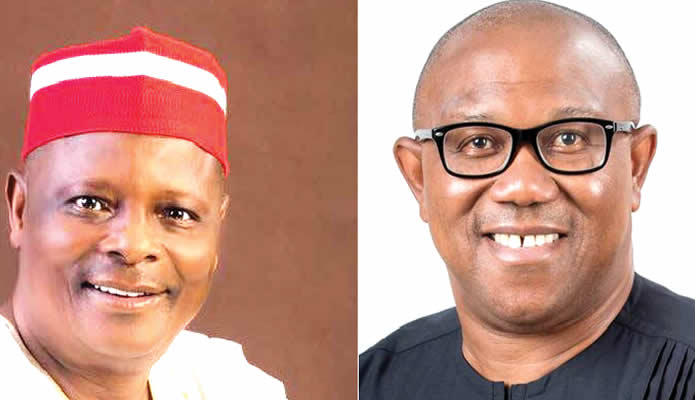
On Tuesday, Rabiu Kwankwaso, the vice-presidential candidate of the Nigeria Democratic Congress, NDC, said that a Peter Obi-led administration would bring back fuel subsidies in a modified form.
Kwankwaso, a former Kano State governor, stated this in an interview with Arise TV on Tuesday.
Media reports that the NDC running mate was discussing the fuel subsidy policy of the President Bola Tinubu-led administration and the positions of presidential candidates ahead of the 2027 election.
Both Obi and Kwankwaso have criticised the current administration’s handling of fuel pricing and agreed that Nigerians need relief from high pump prices.
However, they appear to differ on a key question: whether the subsidy should return.
Recall that Obi, the NDC presidential candidate and former Anambra State governor, has consistently defended the removal of fuel subsidy.
Media reports that his position, as reflected in his 2023 manifesto and subsequent interviews, is that the subsidy should have been removed in a structured and phased manner.
According to Obi, the government should have first tackled corruption and established a transparent pricing framework with operators in the downstream petroleum sector.
Also speaking recently at the Nigerian Bar Association conference in Port Harcourt in August 2026, Obi rejected calls for a return to the old subsidy regime.
“I subscribe and maintain that you need to remove subsidy. Mismanagement of the proceeds shouldn’t be the reason for not removing it,” he said.
The NDC presidential candidate also argued that the savings should have been invested in critical sectors such as healthcare, education and agriculture, while also strengthening the country’s sovereign wealth fund.
Obi further claimed that the government recovered trillions of naira from subsidy removal but failed to transparently channel the funds into productive investments that would cushion the impact on Nigerians.
On the contrary, Media reports that Kwankwaso is approaching the issue from a different direction.
In an exclusive interview with Arise News on Tuesday, the NDC vice-presidential candidate said an Obi-led government would bring back subsidy, although not in the form previously operated.
“We are bringing subsidy in our own way,” Kwankwaso said.
The former Kano governor also faulted President Bola Tinubu’s decision to remove the subsidy on May 29, 2023, arguing that the policy was implemented without adequate preparations.
According to him, the decision contributed to what he described as a “total mess economically.”
Kwankwaso acknowledged that the major contenders in the 2023 presidential election had campaigned on eventually removing the subsidy.
Kwankwaso said the government should encourage and support the expansion of both private and public refineries to ensure that petroleum products are produced locally and supplied at lower prices.
“If individuals in this country can build refineries, I see no reason why government under certain circumstances will not build refineries,” he said.
He added that the objective would be to do “whatever it takes to put the price of oil down.”
The comments have raised questions about how the NDC would reconcile the positions of its presidential and vice-presidential candidates.
While Obi has maintained that Nigeria should not return to the old subsidy regime, Kwankwaso has openly spoken about bringing subsidy back “in our own way.”
Although both men have criticised the manner in which the subsidy was removed and have argued that Nigerians should not continue to bear the full burden of high fuel prices, their approaches differ mainly on the mechanism.
For Obi, the emphasis is on maintaining subsidy removal, preventing waste and corruption, and using the savings to improve public services and the economy.
For Kwankwaso, government intervention should include supporting domestic refining and introducing measures that would bring fuel prices down, including subsidy in a new form.