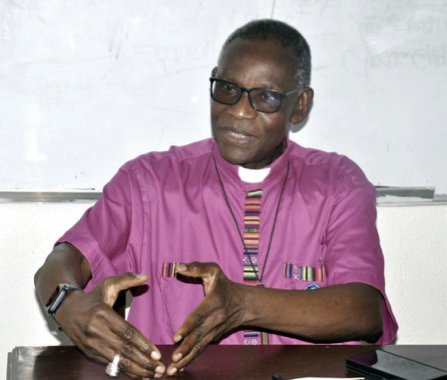
Former Secretary General of the worldwide Anglican Communion and Founder of the Kaduna Centre for the Study of Christian Muslim Relations, Bishop Dr. Josiah Idowu-Fearon, has warned Nigerian politicians against basing their electoral strategies on religious blocs ahead of the 2027 general elections.
Speaking in Kaduna, the respected cleric said no candidate can win the presidency with only Muslim votes or only Christian votes. He specifically told President Bola Ahmed Tinubu and Kaduna State Governor Uba Sani that they cannot win without support from both religious communities.
“If all Christians in Nigeria decide not to vote for Tinubu, he can never be President. I extend the same argument to the Muslim electorate. If only Muslims vote for a Muslim-Muslim ticket, there is no way. The mathematics of Nigerian politics makes it impossible for either major religious constituency to secure national power entirely on its own,” he said.
Bishop Idowu-Fearon applied the same logic to Kaduna politics. He said if all Muslims refused to vote for Governor Uba Sani because of his Muslim-Christian ticket, and only Christians voted, he would not win. The same applies if only Muslims voted.
He drew a distinction between needing “a Muslim or Christian president” and needing “a president who is Christian or Muslim.” According to him, Nigeria does not need leaders defined only by religion, but leaders whose conduct reflects the ethical teachings of their faith. “Neither Islam nor Christianity encourages tribalism, stealing, telling lies or exploiting people. Religious identity by itself should never be regarded as evidence of political integrity,” he stated.
On why some politicians push for religiously balanced or homogeneous tickets, the Bishop said the motivation is often “accessibility” — the belief that having someone from your religious group close to power gives easier access to government. He dismissed that thinking as divisive. He cited his own experience with late President Buhari and former Vice President Namadi Sambo, noting that his Christian identity did not prevent cooperation, and that Buhari and Sambo both supported his Centre despite religious differences.
Looking toward 2027, he urged religious leaders to educate citizens instead of telling them who to vote for. “I appeal to Imams, Sheikhs, Emirs, Bishops and traditional rulers to encourage citizens to participate in elections and critically assess candidates. Voting is ultimately a matter of individual moral responsibility. Every Muslim vote and every Christian vote matters, and God will ask each of us how we used our franchise,” he said.
On Kaduna, the Bishop said his doctoral research showed the state’s political terrain supports Governor Uba Sani’s Muslim-Christian arrangement. However, he reiterated that the ticket alone cannot guarantee victory without votes from both sides. He prayed the arrangement would strengthen cooperation across Kaduna’s three senatorial zones.
He also warned religious leaders against getting too close to politicians. “When you begin to frequent politicians, you get corrupted. If a religious leader regularly hobnobs with a politician, he will definitely get corrupted, and it destroys what I call the religious leader’s prophetic authority. If I give you money and make sure you are very comfortable, you cannot challenge me,” he said. He added that the problem affects both Christian and Muslim leaders.
On the economy, Bishop Idowu-Fearon said Nigerians are genuinely suffering. Drawing from his pastoral work in Kaduna, he said some church members cannot afford transport to worship and many people now eat only one meal a day. He cited rising prices, noting that items like soap and tomatoes now cost thousands. “To say people are not suffering as a result of what is going on in our country is being economical with the truth. Instead of denying it, government should say, we are aware, and this is what we are doing about it,” he said.
In summary, the Bishop argued that while candidates may need a religion, Nigeria needs leadership that rises above religious arithmetic. He called for politics based on character, cooperation and bridge-building rather than reliance on religious constituencies alone.